
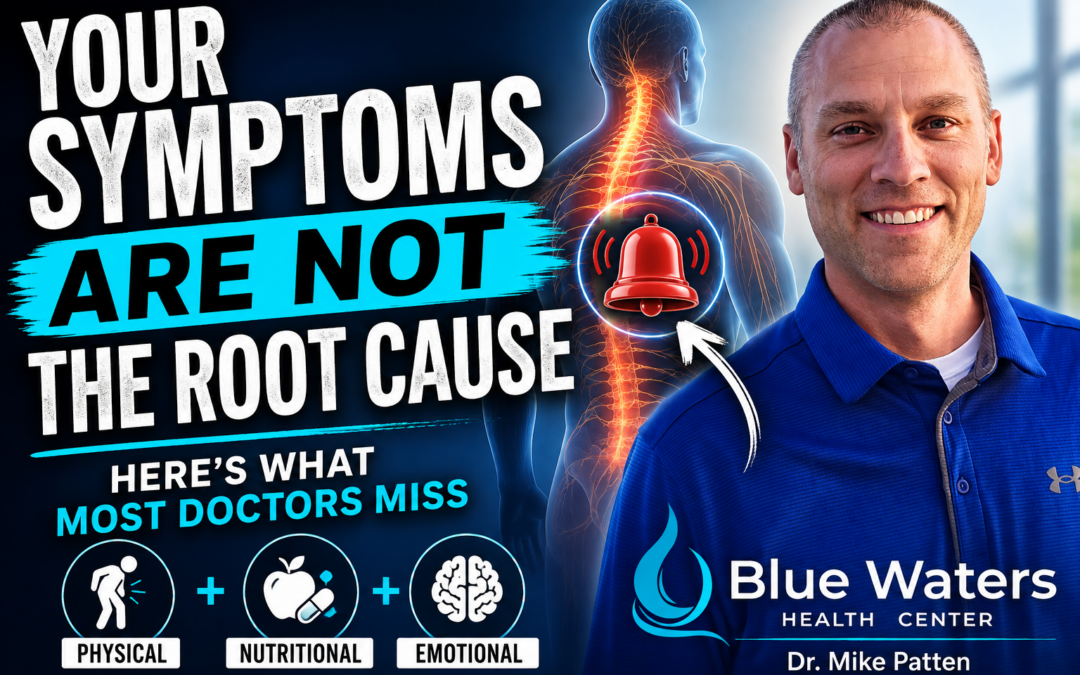
Have you ever had an ache, pain, or other symptom and discovered that the problem was actually coming from somewhere else?
That's more common than you might think.
When a symptom shows up, our natural reaction is to focus on the symptom. My stomach hurts, so something must be wrong with my stomach. My shoulder hurts, so the problem must be in my shoulder.
Sometimes that's exactly right.
But often, the symptom isn't the root cause. It's an alarm bell telling us that something in the body may be out of balance.
And if we only silence the alarm without asking why it's ringing, we may miss the bigger picture.
Symptoms Are Valuable Information
I don't think of symptoms as necessarily being bad. Symptoms give us information.
Think about a fire alarm. You don't want to hear it going off, but the alarm itself isn't the problem. Its job is to tell you there's something you need to pay attention to. Symptoms can work in a similar way.
If someone comes into my office with stomach pain, for example, we're going to look at the stomach. That's the logical first step. We need to make sure there aren't red flags or something more serious that requires appropriate medical attention. But once we've done that, I want to ask another question:
What could be creating this symptom?
That's where looking for the root cause begins.
Start With the Physical
The first place I look is the physical side.
Was there an accident? An injury? A trauma?
If you're playing basketball, roll your ankle, and immediately have ankle pain, we have a pretty good idea of what happened. You were fine. You rolled the ankle. Now it hurts.
There's a clear connection between the physical event and the symptom.
But what happens when there isn't an obvious physical explanation? Then we keep looking.
Next, Look at the Chemical and Nutritional Side
Let's go back to our example of stomach pain.
If we've looked at the physical possibilities, the next area I want to consider is what's going into the body.
- What are you eating?
- What does your nutrition look like?
- What medications or other substances are you taking?
- Could something you're consuming—or something you're missing—be contributing to what you're experiencing?
Again, we're not just asking how to make the stomach stop hurting.
We're asking:
What's driving this train?
That's a very different question.
What About Mental and Emotional Stress?
If we don't find the answer in the physical or nutritional areas, there's another part of the picture we shouldn't ignore.
Our thoughts, beliefs, and emotional responses can affect the nervous system and create very real physical responses in the body.
Maybe there's a situation in your life that continually creates stress. Maybe a strongly held belief is constantly being challenged. Maybe there's something you're struggling with day after day.
That doesn't mean the symptom is "all in your head." And it doesn't mean every persistent symptom has an emotional cause.
It means we're looking at the whole person and recognizing that physical, chemical, and mental or emotional stresses can all influence how the body responds.
Sometimes understanding what's driving a symptom means looking at all three.
The Goal Isn't Just to Cover Up the Alarm
If a fire alarm is going off, you don't solve the problem by taking the battery out. You find the fire. That's how I want to approach symptoms.
There are certainly times when symptom relief is important. But I don't want to stop there if we haven't answered the bigger question.
- Why is the symptom there in the first place?
- What is the body trying to tell us?
- Is there something physical that needs to change?
- Is there something nutritional or chemical that needs to change?
Is there an ongoing source of mental or emotional stress that needs to be addressed?
When we identify what may be keeping the body under stress, we have a better opportunity to help the nervous system move away from that constant state of response and toward the rest-and-recovery activity associated with the parasympathetic nervous system.
That's where the body's natural ability to heal, repair, and recover becomes so important.
When Symptoms That Seem Unrelated May Be Connected
This is also where things get particularly interesting.
Sometimes people have several symptoms that seem completely unrelated. Maybe there's a stomach issue along with shoulder or neck discomfort. On the surface, those problems may look like separate things.
But the body doesn't function as a collection of completely independent parts. The nervous system, spine, muscles, and other structures of the body continually interact.
At Blue Waters Health Center, one of the tools I use to explore these relationships is the ONE Technique.
The ONE Technique helps us look for patterns and correlations between symptoms, areas of the body, muscular responses, and specific spinal levels.
Rather than assuming that every symptom represents a separate problem, we're asking whether there may be a larger pattern connecting what the person is experiencing.
That can give us another way to investigate what may be driving the train.
Look for the Pattern Behind the Symptom
When you've had a symptom for a long time—or when symptoms keep coming back—it's worth asking whether you're looking only at the alarm or whether you've investigated why the alarm keeps going off.
That's why I like to work through the process logically:
Physical. Nutritional and chemical. Mental and emotional.
- What category are we dealing with?
- What patterns do we see?
- What does the body appear to be responding to?
- And can seemingly unrelated symptoms give us clues that help us understand the bigger picture?
The symptom matters.
But sometimes the most useful question isn't simply "How do we make this symptom go away?"
It's:
"Why is the body creating this symptom in the first place?"
That's where the search for the root cause really begins.
Looking Beyond Your Symptoms
At Blue Waters Health Center, we don't want to look only at where you hurt. We want to understand why your body may be responding the way it is.
That's why our approach considers the whole picture—including physical, nutritional and chemical, and mental or emotional stresses—while looking for patterns that may help us better understand what's happening.
If you've been dealing with recurring or persistent symptoms and want to take a deeper look at what may be contributing to them, schedule an appointment at Blue Waters Health Center.
Frequently Asked Questions About Symptoms and Root Causes
Are symptoms always the root cause of a health problem?
No. Sometimes a symptom directly reflects the problem—for example, ankle pain immediately following an ankle injury. But symptoms can also be signals that something else is affecting the way the body is functioning. That is why Dr. Mike looks beyond the symptom to ask what may be creating or contributing to it.
Why does Dr. Mike describe symptoms as an “alarm bell”?
An alarm tells you that something needs attention, but the alarm itself isn't necessarily the problem. In the same way, a symptom can provide valuable information that something in the body may be out of balance. The next question is what is causing the alarm to sound.
What types of stress can contribute to symptoms?
Dr. Mike looks at three broad areas: physical stress, chemical or nutritional stress, and mental or emotional stress. An injury may create physical stress, diet or substances may contribute to chemical stress, and ongoing thoughts, beliefs, or emotional situations may influence the nervous system.
Can stress or emotions cause physical symptoms?
Mental and emotional stress can create real physiological responses through the nervous system and may influence how the body functions. This doesn't mean every symptom is caused by stress or that physical symptoms are “all in your head.” Persistent or unexplained symptoms should always be evaluated appropriately.
Why might symptoms in different parts of the body be related?
The body functions as an interconnected system. The nervous system, spine, muscles, and other structures influence one another, so symptoms that initially appear unrelated may sometimes be part of a larger pattern. At Blue Waters Health Center, Dr. Mike uses the ONE Technique as one tool for exploring these relationships.
What does “finding the root cause” mean at Blue Waters Health Center?
It means looking beyond symptom relief to investigate what may be contributing to the body's response. Dr. Mike works through the possibilities logically—considering physical, nutritional or chemical, and mental or emotional factors—while looking for patterns that may help explain what the patient is experiencing.