
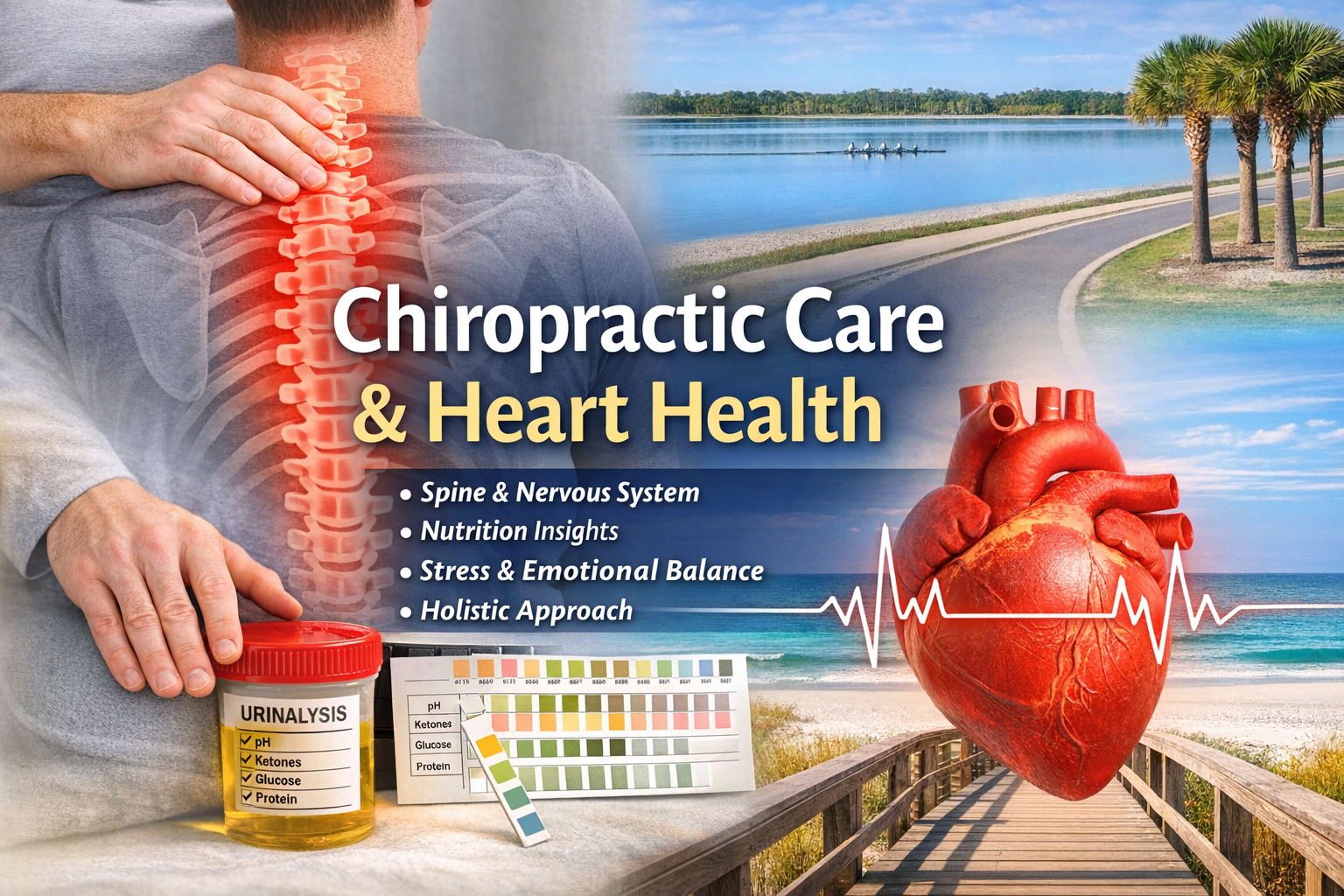
Holistic Chiropractic Care in Sarasota, FL (Near Siesta Key, Benderson Park, Palmer Ranch & Venice)
Chiropractic Care and Heart Function: A Holistic, Nervous-System–Based Approach
If you’ve been wondering how chiropractic care might relate to heart function, heart rhythm awareness, stress, breathing, or overall cardiovascular efficiency,
this guide breaks it down in plain language. You’ll learn how the upper thoracic spine (T1–T6), the vagus nerve, diaphragm mechanics, nutrition, and daily habits
all influence how the heart adapts and recovers.
Want a nervous-system–based assessment? If you’re in Sarasota, Siesta Key, Palmer Ranch, Venice, or nearby, we can help you get clarity on what’s driving stress patterns in your body.
Direct Answer: Can Chiropractic Care Support Heart Health?
Direct answer: Chiropractic care may support heart health indirectly by improving nervous system regulation, upper thoracic (T1–T6) and cervical spinal mobility,
breathing mechanics, and stress recovery. While it does not treat heart disease, restoring spinal motion can reduce neurological and physical stress that influences heart rate,
rhythm awareness, and overall cardiovascular efficiency.
In simple terms, chiropractic doesn’t work on the heart itself—it helps the systems that control how the heart adapts to stress, breathing, and recovery.
Who This Is For—and What Problem It Solves
This article is for people who want a natural, holistic way to support heart health, especially if you’ve been experiencing things like stress overload,
shallow breathing, tension through the upper back, “fight-or-flight” feelings, fatigue, or the sense that your body never really slows down.
It also answers common real-world questions like:
- “Can chiropractic care affect heart function?”
- “What part of the spine is connected to the heart?”
- “Can stress or anxiety make my heart race?”
- “How do I improve vagus nerve tone naturally?”
- “Why do my tests look normal, but I still feel off?”
I’m a holistic chiropractor in Sarasota, Florida, and I work with people from Siesta Key, Benderson Park, Palmer Ranch, and Venice who want a calmer,
more logical approach that looks at the body as a connected system—not just a list of symptoms.
Important Safety Note
If you have new or worsening chest pain, fainting, severe shortness of breath, or symptoms that feel urgent, seek emergency care immediately.
This article is for education and does not replace medical diagnosis or treatment.
Can Chiropractic Care Affect Heart Function?
Short answer: yes—indirectly, but meaningfully. Chiropractic care doesn’t “treat the heart.”
Instead, it supports the systems that regulate how the heart functions, including the nervous system, breathing mechanics, spinal mobility, stress response, and recovery.
What Part of the Spine Is Connected to the Heart?
The heart is most closely connected to the upper thoracic spine, especially spinal levels T1 through T6.
These levels contribute nerve fibers that influence heart rate, rhythm, and contractility. The upper cervical spine also matters because of its relationship to
the vagus nerve and overall autonomic balance.
- T1–T6: sympathetic input that influences heart rate, rhythm, and cardiac workload
- C1–C5: relationships affecting vagal tone and diaphragm mechanics (via key nerve pathways)
How the Nervous System Influences Heart Health
The heart is regulated by the autonomic nervous system, which has two main branches:
- Sympathetic (fight-or-flight): “go mode,” higher output, higher alertness
- Parasympathetic (rest-and-recovery): “recovery mode,” calmer rhythm, better adaptation after stress
A lot of people searching for heart-health answers aren’t experiencing a “bad heart”—they’re experiencing a body that’s stuck in stress physiology.
And when the nervous system is overloaded, the heart often feels it first.
The Phrenic Nerve, Vagus Nerve, and Why Breathing Matters
Phrenic nerve and diaphragm mechanics (C3–C5)
The diaphragm is one of the most under-appreciated pieces of heart support. It’s controlled by the phrenic nerve, and diaphragm motion affects oxygen efficiency,
pressure changes in the chest, and blood return to the heart.
When diaphragm movement is restricted, you often see:
- Shallow breathing patterns
- Higher stress signaling to the nervous system
- More tension through the chest and upper back
- More “work” required from the heart to maintain output
Vagus nerve and heart regulation
The vagus nerve is strongly connected to recovery physiology. It supports parasympathetic tone—helping the heart slow down, regulate rhythm awareness, and recover after stress.
When people feel like they “can’t shut off,” that’s often a vagal tone conversation.
Why Upper-Thoracic Mobility (T1–T6) Can Matter So Much
One of the first things I look at for heart support is simple: does the upper spine move well?
Stiffness in the upper thoracic region often correlates with tension patterns, breathing restriction, and reduced adaptability.
When spinal segments move freely, the nervous system tends to regulate more efficiently.
How the ONE Technique Applies to Heart Health
This is where my approach becomes very precise. Rather than adjusting everything, I use a method called the ONE Technique.
The idea is simple: most people have one primary spinal segment that’s driving the majority of the imbalance. When you identify and correct that ONE segment,
the body often starts reorganizing in a logical way.
If you’d like to read more about how we think about root-cause patterns, you can also explore:
What Is the ONE Technique?
Different “systems,” different segments
Heart support can show up through different systems. Using a systems-based perspective, the ONE segment may correlate with which system is under the most stress:
- Circulatory emphasis (often T2): circulation, rhythm regulation, vascular tone
- Muscular emphasis (often T5): because the heart is a muscle and workload matters
- Nervous system emphasis (often T4): stress overload, anxiety patterns, fight-or-flight dominance
- Chemical/glandular emphasis (often C1): autonomic balance and recovery physiology
The goal is not to guess. The goal is to find what’s most involved and restore motion and regulation where it matters most.
Nutritional Support: Why We Use the Integrated Urinalysis Panel (IUP)
Structure is one side of the story. Chemistry is the other.
The heart has specific nutritional and metabolic requirements, and if you’re guessing supplements, you’re often guessing wrong.
That’s why we use the Integrated Urinalysis Panel (IUP)—to evaluate patterns related to mineral utilization,
metabolic stress, enzyme efficiency, and acid–base balance.
With the IUP, we’re looking for clarity around things like:
- Mineral and electrolyte stress patterns (important for rhythm regulation)
- Metabolic workload signals (how hard the body is “running” internally)
- Acid–base patterns that can influence fatigue and recovery
- Whether targeted nutritional support is appropriate (precision over excess)
If you’re new to this concept, the simplest way to say it is: we want to make sure the heart’s environment is supportive—not depleted, not overloaded, and not guessing.
The Four Physical Laws That Support a Healthy Heart
Long-term heart support isn’t just structural. It’s also lifestyle alignment—making sure your day-to-day life obeys the body’s physical requirements.
I break that down into four “laws” that people can actually apply:
1) Movement
The heart stays healthy with movement. This doesn’t mean you have to train like an athlete—it means your body needs consistent motion.
In Sarasota, I love seeing people walking at Benderson Park or spending time outside near Siesta Key. Movement supports circulation and adaptability.
2) Rest
Rest is where the heart gets to recover. If sleep is inconsistent or you’re constantly “wired,” your heart is often forced to perform without a true recovery cycle.
Better recovery supports better regulation.
3) Sanitation
Sanitation is about eliminating waste efficiently—keeping the internal environment clean so the heart is supported by rich, vibrant circulation rather than congestion or toxicity patterns.
4) Digestion
The heart can’t use nutrients you don’t absorb. Digestion determines whether the body can deliver the raw materials needed for normal function and recovery.
This is another reason the IUP can be useful—because it helps reveal patterns that explain “why I’m doing everything right but still feel off.”
The Emotional Side of Heart Stress (Without Overanalyzing It)
There’s a real emotional component to heart stress patterns. Many people describe feeling like they’re always on a treadmill—always “on,” always rushing,
never really able to exhale. Relationship stress, unresolved worry, chronic anxiety, and feeling trapped in fight-or-flight physiology can all show up through the chest,
breathing, and rhythm awareness.
In my experience, the most effective approach isn’t forcing emotional change—it’s restoring physiological regulation.
When the nervous system calms and the spine moves, the emotional patterns often soften naturally.
How to Think About Heart Health From a Holistic Chiropractic Perspective
Rather than jumping straight to labels, a holistic approach looks at how the body is adapting—and what systems may be under stress.
Here’s a practical way to think through heart-related concerns:
1) Make sure nothing urgent is being missed
If you’re experiencing new, severe, or rapidly worsening symptoms (like intense chest pain, fainting, or sudden shortness of breath),
those situations should be evaluated immediately through appropriate medical care.
2) Ask whether stress and recovery are balanced
Many people ask, “Why do my tests look normal, but I still feel off?” Often the issue isn’t damage—it’s regulation.
If you never feel like your body truly slows down, that’s a nervous system conversation.
3) Look at how the spine and nervous system are functioning
- Motion in the upper thoracic spine (T1–T6)
- Function in the upper cervical spine (autonomic regulation relationships)
- Overall adaptability—how well your body transitions from stress to recovery
4) Consider breathing mechanics and diaphragm function
Restricted diaphragm movement can increase cardiac workload and reinforce stress breathing patterns.
Restoring spinal motion often supports more efficient breathing and recovery.
5) Evaluate nutrition and metabolism thoughtfully
Tools like the Integrated Urinalysis Panel (IUP) can help identify mineral, enzyme, and metabolic stress patterns so support is targeted and logical.
6) Align daily habits with the body’s physical laws
- Consistent movement
- Adequate rest
- Efficient elimination (sanitation)
- Healthy digestion and nutrient delivery
7) Notice the emotional pattern
If you feel constantly rushed or stuck in fight-or-flight, restoring physiological balance often allows emotional patterns to settle without forcing anything.
A Holistic Chiropractic Approach to Heart Health in Sarasota
At Blue Waters Health Center in Sarasota, we approach heart support by looking at the full picture:
nervous system regulation, spinal motion, breathing mechanics, lifestyle rhythms, emotional stress patterns, and targeted nutrition.
- ONE Technique analysis to identify the primary segment involved
- Focused care that supports nervous system regulation
- IUP insight to guide targeted nutrition and metabolic support
- Practical coaching on movement, rest, sanitation, and digestion
If you’re near Siesta Key, Benderson Park, Palmer Ranch, Venice—or anywhere in Sarasota—and you want a calm, precise approach that respects the body’s ability to regulate,
we’re here to help.
Schedule Your Visit
Explore Our Services
Key Takeaways on Chiropractic and Heart Health
- The heart is regulated by the nervous system, which is influenced by spinal function and mobility.
- The upper thoracic spine (T1–T6) is a key region involved in heart-related regulation patterns.
- Breathing mechanics and diaphragm function can influence cardiac workload and recovery.
- The ONE Technique focuses on identifying the single spinal segment contributing most to imbalance.
- The Integrated Urinalysis Panel (IUP) helps guide targeted nutritional and metabolic support.
- Movement, rest, sanitation, and digestion are foundational physical laws for long-term heart support.
- Stress and fight-or-flight patterns can strongly affect rhythm awareness and recovery physiology.
FAQ: Chiropractic Care and Heart Health
Can chiropractic care treat heart disease?
No. Chiropractic care does not treat heart disease. It may support nervous system regulation and reduce physical stress that influences how the heart adapts to daily demands, recovery, and stress.
What part of the spine affects the heart the most?
The heart is most closely connected to the upper thoracic spine, especially spinal levels T1 through T6, as well as the upper cervical spine through its relationship with autonomic regulation and the vagus nerve.
Can stress or anxiety affect heart function?
Yes. Chronic stress and anxiety can shift the nervous system into a persistent fight-or-flight state, which may increase heart rate, tension, and awareness of heartbeat even when the heart itself is structurally healthy.
How is the vagus nerve connected to heart rate?
The vagus nerve supports parasympathetic tone, which helps slow the heart rate, promote recovery, and improve heart rate variability after stress.
Why does breathing affect the heart?
Breathing influences pressure changes in the chest, oxygen delivery, and blood return to the heart. Restricted diaphragm movement can increase cardiac workload and reinforce stress-based breathing patterns.
Can chiropractic help if cardiac tests are normal?
Often, yes. Many people have normal cardiac testing but still experience symptoms related to nervous system imbalance, stress overload, restricted breathing mechanics, or spinal motion that affects regulation rather than structure.
What is the ONE Technique and why does it matter?
The ONE Technique is a chiropractic approach that focuses on identifying the single spinal segment creating the greatest imbalance, allowing care to be precise, efficient, and system-specific rather than generalized.
Is chiropractic care safe for people concerned about heart health?
Chiropractic care is generally considered safe when provided by a licensed chiropractor and when appropriate screening is performed. New, severe, or worsening heart symptoms should always be medically evaluated first.