
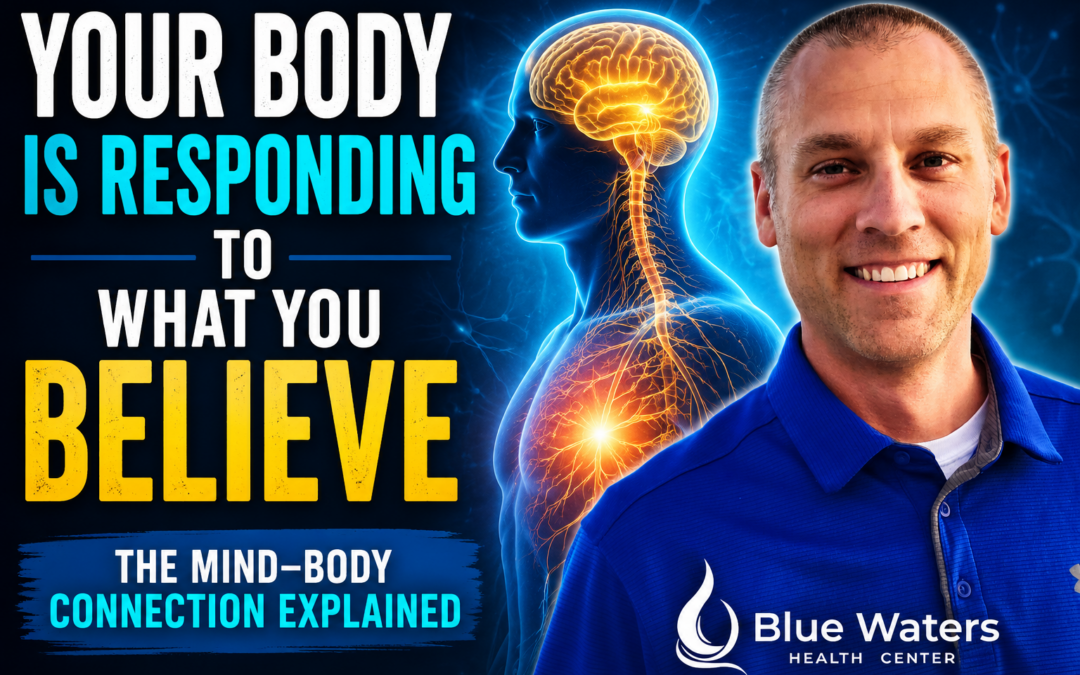
Have you ever wondered how the mind-body connection actually works?
We hear people talk about the connection between our thoughts and our physical health, but what does that really mean?
The simplest place to start is this: your mind is constantly changing.
Every new experience, every conversation, every book you read, and every piece of information you take in has the potential to change the way you think. Your mind is constantly learning, adapting, and becoming.
And what happens in your mind can affect what happens in your body.
Your Thoughts Can Create a Physical Response
Let's say something happens that conflicts with a belief you hold strongly.
Your brain receives that information and may interpret it as a stressor. When that happens, it can activate the sympathetic nervous system—the part of the nervous system involved in our fight-or-flight response.
Your heart rate can increase. Blood pressure can rise. Blood sugar can increase. Your body is preparing to respond to a perceived threat.
That's a very useful response if you need to get out of danger.
But here's where it gets interesting:
The threat doesn't necessarily have to be physical.
A thought, belief, conversation, or situation can also trigger that response.
Here's a Simple Example
I'm a Minnesota Timberwolves fan.
Now, let's say someone walks up to me and says, "The Timberwolves are terrible."
If I have a strongly held belief that they're a great team—and I'm really attached to that belief—I may immediately want to defend them.
I might argue. I might get angry. My heart rate may go up. My body starts preparing me to fight.
Nobody is chasing me. I'm not physically in danger.
Someone just challenged something I believe.
That's the mind-body connection playing out in real time.
Of course, an argument about a basketball team probably isn't going to last very long.
But what if the source of stress happens every day?
What Happens When the Stress Doesn't Go Away?
Maybe you really don't like your job.
You wake up thinking about it. You drive to work thinking about it. You spend eight hours in an environment you don't want to be in, and then you go home knowing you're going to do it again tomorrow.
Day after day, the body can continue responding to that stress.
Over time, prolonged stress can affect how the body functions. You may begin noticing that you don't feel right. Maybe your stomach bothers you. Your muscles stay tight. Your heart feels like it's beating too fast. You feel exhausted or constantly on edge.
That doesn't mean every physical symptom is caused by stress or by something you're thinking. Symptoms can have many causes, and they should be evaluated appropriately.
But it does mean we shouldn't ignore what may be happening on the mental and emotional side of the equation.
Sometimes the question isn't only:
"What's happening in my body?"
It may also be:
"What is my body responding to?"
Are You Stuck on One Side?
Another way I like to think about this is polarization.
Imagine something with two poles—two opposite ends.
Maybe you think hiking is the greatest thing in the world. Someone else thinks hiking is the dumbest way imaginable to spend a Saturday afternoon.
If you're completely stuck on one side, you may feel the need to defend your position whenever somebody challenges it.
But step back for a moment.
What is hiking?
It's a form of exercise.
You can enjoy it. Someone else can dislike it. Neither opinion has to create a threat.
When we can begin to see the bigger picture, we don't have to react to everything that challenges what we believe.
And that can change what happens in the body.
We Build Our Minds Over Time
Our beliefs come from somewhere.
They come from our experiences, what we've learned, what we've read, what other people have told us, and the things we've spent time thinking about.
Over time, we build our minds around those experiences and beliefs.
Then those beliefs influence the way we interpret what's happening around us.
And the way we interpret the world can influence how our nervous system responds.
That's the mind-body connection.
Sometimes Healing Means Looking at the Whole Picture
When symptoms show up, our natural response is to ask, "What's wrong?"
We look for the physical problem—and we should.
But sometimes we also need to look at the stresses, thoughts, and beliefs that may be keeping the body in a constant state of response.
That doesn't mean you have a mental-health disorder or that your symptoms are "all in your head."
I'm talking about something much simpler.
Sometimes it's a thought.
Sometimes it's a belief.
Sometimes it's the way we've learned to interpret a situation.
And sometimes changing the way we see something can change the way our body responds to it.
The goal isn't to force yourself to think positively or pretend that difficult things aren't difficult.
It's to become more aware.
What am I reacting to?
Why does this affect me so strongly?
Is there another way I could see it?
When we can move away from that constant state of fight or flight and allow the body to be more at ease, we create a better environment for the body to do what it is designed to do:
heal, repair, and recover.
That's one of the most important things to understand about the mind-body connection.
Looking Beyond the Symptom
At Blue Waters Health Center, one of the things we continually ask is not just where does it hurt? but why is the body responding the way it is?
The answer isn't always found in one place.
Physical stresses matter. Chemical stresses matter. And the thoughts, beliefs, and experiences that influence the nervous system can matter, too.
Understanding the whole picture can help us better understand what may be interfering with the body's ability to function the way it was designed to function.
Your content goes here. Edit or remove this text inline or in the module Content settings. You can also style every aspect of this content in the module Design settings and even apply custom CSS to this text in the module Advanced settings.
FAQs
What is the mind-body connection?
The mind-body connection describes the relationship between our thoughts, beliefs, emotions, nervous system, and physical responses. What we perceive or experience mentally can influence the way the nervous system responds, which can in turn affect processes throughout the body.
Can thoughts really cause a physical response in the body?
Yes. A stressful thought, experience, or perceived threat can activate the sympathetic nervous system, often called the fight-or-flight response. This can temporarily increase heart rate, blood pressure, blood sugar, muscle tension, and other physical responses.
Can chronic stress affect physical health?
Prolonged or repeated stress can influence many systems in the body and may contribute to physical symptoms or changes in how the body functions. Stress is not the cause of every symptom, however, so ongoing or unexplained symptoms should be evaluated appropriately.
Does the mind-body connection mean symptoms are "all in your head"?
No. Physical symptoms are real and can have many different causes. Understanding the mind-body connection simply recognizes that mental, emotional, physical, and other forms of stress can interact with the nervous system and influence the way the body responds.
How can changing the way I think affect my body's stress response?
Becoming aware of thoughts, beliefs, or situations that repeatedly trigger stress may help you respond to them differently. When the nervous system spends less time in a heightened fight-or-flight state, the body may have greater opportunity to rest, regulate, repair, and recover.
If you have questions about what you're experiencing or would like to take a deeper look at your health, we invite you to schedule an appointment at Blue Waters Health Center.