
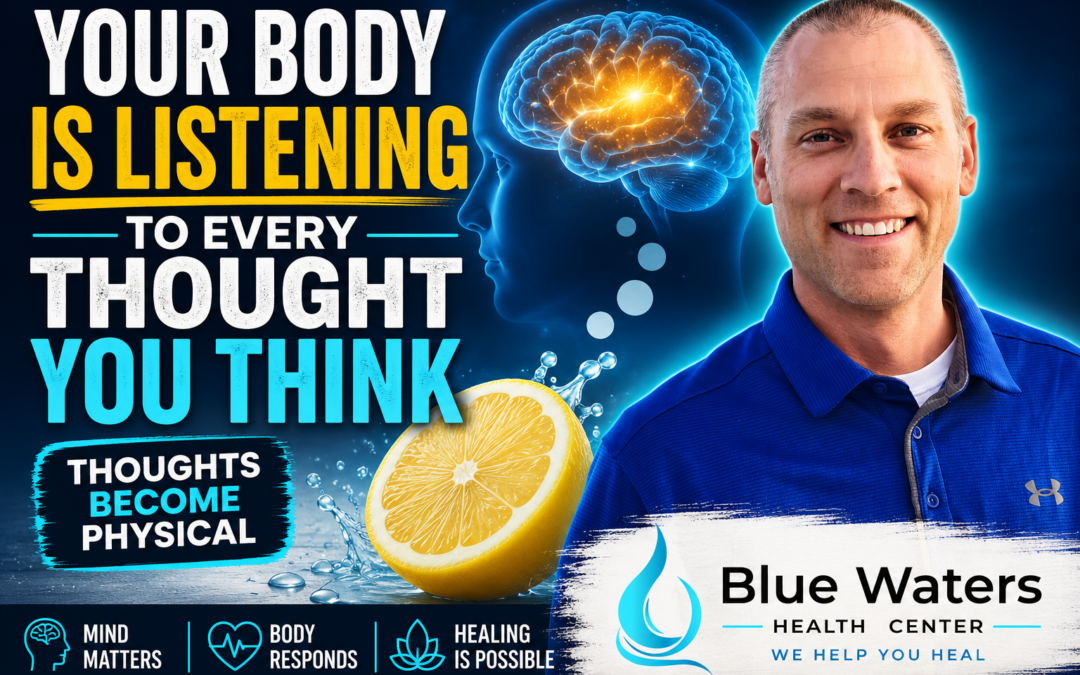
Your Body Is Listening: How Your Thoughts Influence Your Health and Healing
"The thoughts you rehearse become the patterns your body begins to recognize."
Have you ever noticed that simply imagining biting into a fresh lemon can make your mouth water?
You didn't actually taste anything.
There wasn't a lemon in the room.
Yet your body responded as though it were real.
That simple exercise reveals something remarkable about the relationship between your mind and your body: your nervous system responds not only to what is happening around you, but also to what your brain believes is happening.
At Blue Waters Health Center, we believe healing involves far more than treating symptoms. The body functions as an integrated system where physical structure, nutrition, environment, emotions, and thought patterns all influence health.
Understanding how your thoughts affect your body may become one of the most empowering steps you take toward lasting wellness.
The Lemon Experiment: Proof That Thoughts Create Physical Responses
Let's try a quick exercise.
Picture a bright yellow lemon resting on your kitchen counter.
Imagine picking it up.
Feel the texture of the peel.
Cut it open and watch the juice glisten.
Now squeeze it over your hand.
Finally...
Take a big bite.
Did your mouth begin watering?
Many people immediately notice increased saliva or even a slight pucker in their cheeks.
Nothing physically happened.
Yet your nervous system prepared your body for eating.
This is one of the simplest demonstrations of the powerful connection between thought and physiology.
Your brain doesn't always distinguish sharply between a vividly imagined experience and a real one. When you focus your attention long enough, your body often begins preparing for what your mind expects.
"Your body isn't listening to every passing thought—it responds most powerfully to the thoughts you rehearse every day."
— Dr. Mike Patten

Not Every Thought Matters—But the Ones You Rehearse Do
Every day we experience thousands of thoughts.
Most come and go without much impact.
What matters is not the fleeting thought.
It's the thought we return to again...
and again...
and again.
Repeated attention strengthens neural pathways in the brain—a process often described as "neurons that fire together, wire together."
The more often we think a certain way, the more familiar that pathway becomes.
Eventually, those thought patterns can influence our emotions, behaviors, stress responses, muscle tension, breathing, sleep, and many other aspects of health.
In other words, our bodies learn what our minds repeatedly rehearse.
Your Brain Is Constantly Predicting
Modern neuroscience tells us that the brain is not simply reacting to the world—it is constantly predicting it.
Based on your previous experiences, your brain continually asks:
- Is this safe?
- Is this dangerous?
- Should I prepare for action?
- Can I relax?
Those predictions influence the autonomic nervous system—the network that regulates heart rate, digestion, muscle tone, breathing, immune function, and countless other automatic processes.
If your mind repeatedly anticipates danger, stress, conflict, or failure, your body may remain in a heightened state of readiness.
If your thoughts regularly reinforce safety, hope, confidence, and resilience, your nervous system is more likely to shift toward rest, repair, and recovery.
This doesn't mean positive thinking cures disease.
It means your patterns of thought can become one of many influences on how your body functions every day.
Why Past Experiences Shape Present Reactions
During the lemon exercise, not everyone responds the same way.
Someone who loves lemons may smile.
Someone who had a bad childhood experience involving lemons may react very differently.
The difference isn't the lemon.
It's the meaning attached to it.
Our brains store experiences along with emotional significance.
When similar situations arise, those stored memories can trigger immediate physical responses before we're even consciously aware of them.
This is why two people can experience the exact same event while their bodies react in completely different ways.
Our history helps shape our physiology.
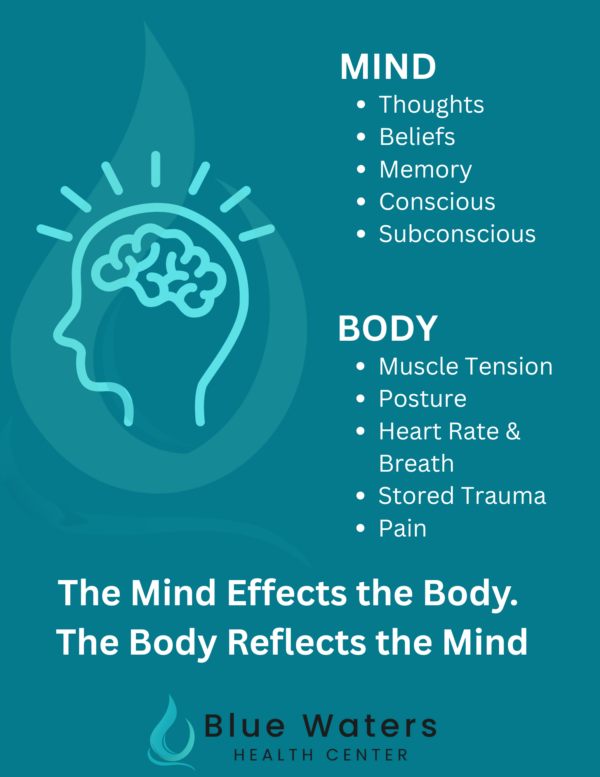
Chronic Stress Begins with Repeated Patterns
Stress is not simply caused by difficult circumstances.
It's also influenced by how consistently our minds return to those circumstances.
Imagine replaying the same worry every day:
"What if I never get better?"
"Something must be terribly wrong."
"I'll probably always feel this way."
Those thoughts may increase muscle tension, elevate stress hormones, disrupt sleep, and encourage a cycle of ongoing worry.
The body begins responding to the story it hears most often.
Fortunately, the opposite is also true.
When we gradually develop healthier ways of thinking, our nervous system can begin responding differently over time.
Health Is More Than One Dimension
At Blue Waters Health Center, we recognize that health challenges rarely come from a single source.
Dr. Mike often describes three broad categories that influence our well-being:
Mechanical
Physical injuries, poor posture, repetitive movement, falls, accidents, and structural stress.
Chemical
Nutrition, environmental toxins, medications, inflammation, hydration, and other biochemical influences.
Emotional
Stress, unresolved emotions, beliefs, thought patterns, and the way our nervous system processes life experiences.
These three dimensions constantly interact.
Addressing only one while ignoring the others may leave important pieces of the puzzle unexplored.
Whole-person healing begins by considering the entire picture.
Where You Place Your Attention Matters
Our attention acts like a spotlight.
Whatever we consistently illuminate tends to grow stronger.
This doesn't mean ignoring real problems.
Rather, it means choosing whether our attention becomes trapped by them.
Ask yourself:
- What do I spend the most time thinking about?
- Does this thought help me heal?
- Does it move me toward hope or fear?
- Am I replaying the past or building toward the future?
These questions aren't about denying reality.
They're about becoming aware of the habits that quietly shape our nervous system every day.

Perspective Can Change Everything
One idea Dr. Mike shares is that many situations are neither entirely good nor entirely bad.
Our interpretation often determines how strongly we react.
The lemon itself isn't good or bad.
It's simply a lemon.
Likewise, many challenges become less overwhelming when we learn to view them from a different perspective.
Changing perspective doesn't erase difficulty.
It often reduces unnecessary suffering.
That mental flexibility allows our nervous system to respond with greater balance instead of remaining locked in constant fight-or-flight mode.
Small Mental Shifts Can Support Better Health
You don't need to control every thought that enters your mind.
No one can.
But you can become more aware of which thoughts you repeatedly nurture.
Small daily practices can help support a healthier mindset:
- Practicing gratitude
- Spending time outdoors
- Prayer or meditation
- Mindful breathing
- Journaling
- Positive visualization
- Meaningful relationships
- Regular movement
- Professional guidance when needed
These habits don't replace appropriate healthcare.
They complement it by supporting a healthier nervous system.
Whole-Person Healing at Blue Waters Health Center
At Blue Waters Health Center, our goal isn't simply to reduce pain.
It's to help people function better by understanding how the body's systems work together.
Structural alignment.
Nervous system function.
Movement.
Nutrition.
Lifestyle.
And yes—even the patterns of thought we rehearse every day.
Healing isn't just about fixing what's broken.
It's about creating the conditions in which the body can do what it was designed to do.
When we begin paying attention to what we're consistently thinking, we often discover another powerful tool for supporting long-term health and wellness.
Dr. Mike Patton
"Your body isn't listening to every passing thought—it responds most powerfully to the thoughts you rehearse every day."
Dr. Mike goes into detail on his YouTube Channel. Hear it from the doctor himself! (It's fun, too.)
Final Thoughts
Your body probably isn't responding to every passing thought.
But it is paying attention to the thoughts you return to repeatedly.
Those repeated patterns influence your nervous system, your stress response, your habits, and ultimately the way you experience your health.
So today, ask yourself one simple question:
What am I teaching my body to expect?
The answer may be the beginning of a healthier tomorrow.
Frequently Asked Questions
1. Can your thoughts really affect your physical health?
Yes. Research has shown that thoughts and emotions can influence the nervous system, stress hormones, heart rate, muscle tension, breathing, and other physiological processes. While thoughts alone do not determine health, persistent patterns of thinking can affect how the body responds to stress and recovery.
2. Why did my mouth water when I imagined biting into a lemon?
Your brain can trigger physical responses based on vivid mental imagery. When you imagined the lemon, your nervous system prepared your body as if you were actually about to eat it, stimulating saliva production. It's a simple demonstration of the connection between the mind and the body.
3. Does negative thinking cause illness?
Health conditions are rarely caused by a single factor. Physical injuries, nutrition, environmental exposures, genetics, and lifestyle all play important roles. However, chronic stress and persistent negative thought patterns may contribute to how the body functions and how symptoms are experienced over time.
4. What is the mind-body connection?
The mind-body connection describes the ongoing communication between your brain, nervous system, hormones, immune system, and the rest of your body. Mental and emotional states can influence physical function, while physical health also affects mood and thinking.
5. How does chronic stress affect the nervous system?
Long-term stress may keep the nervous system in a heightened "fight-or-flight" state. This can contribute to muscle tension, poor sleep, fatigue, digestive issues, increased inflammation, and difficulty recovering from physical stressors.
6. What does Blue Waters Health Center mean by whole-person healing?
Whole-person healing recognizes that health is influenced by many interconnected factors, including physical structure, nervous system function, nutrition, lifestyle habits, emotional well-being, and stress. Rather than focusing only on symptoms, care is directed toward supporting the body's overall ability to function and heal.
7. What are the three major sources of stress discussed by Dr. Mike?
Dr. Mike describes three broad categories that may influence health:
- Mechanical stress, such as injuries, poor posture, repetitive motion, or accidents.
- Chemical stress, including nutrition, medications, environmental toxins, and inflammation.
- Emotional stress, including chronic worry, unresolved emotions, and persistent thought patterns.
Understanding all three helps create a more complete picture of health.
8. Can changing my mindset improve my health?
Developing healthier thought patterns may help reduce stress, improve resilience, and support healthy nervous system function. While mindset is not a replacement for medical care, it can be an important part of a comprehensive wellness plan.
9. How can I become more aware of unhealthy thought patterns?
Practices such as mindfulness, journaling, meditation, prayer, counseling, and simply pausing to notice recurring thoughts can help increase awareness. Recognizing repetitive thought patterns is often the first step toward changing them.
10. How does chiropractic care fit into whole-person wellness?
At Blue Waters Health Center, chiropractic care is part of a broader approach to health. By supporting proper movement, spinal function, and nervous system communication, chiropractic care is integrated with lifestyle education and wellness strategies to help patients improve function and overall well-being.